Waterproof Design for Outdoor Plastic Enclosures: Sealing, Venting, Drainage and Mold Engineering

Table of Contents

Introduction

Outdoor plastic enclosures are widely used for electrical equipment, lighting systems, energy storage products, agricultural devices, communication equipment, sensors and industrial control systems. Unlike indoor housings, these products must operate reliably while exposed to rain, humidity, dust, temperature changes and sometimes direct water spray.

Selecting a weather-resistant plastic is important, but material selection alone cannot make an enclosure waterproof.

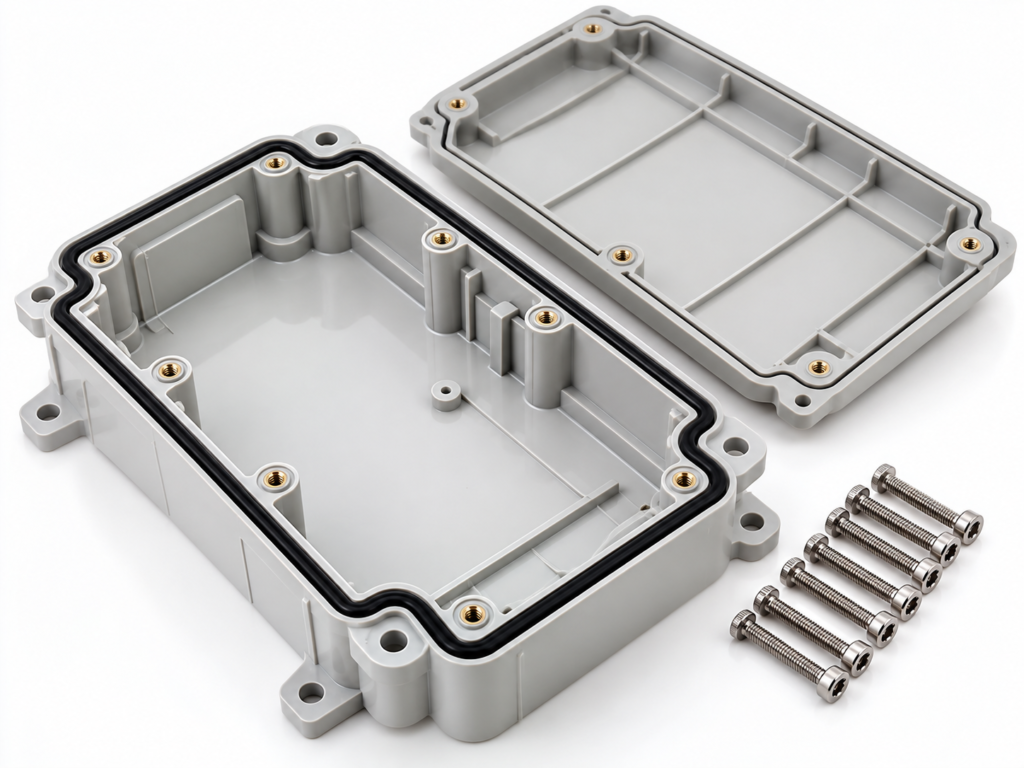
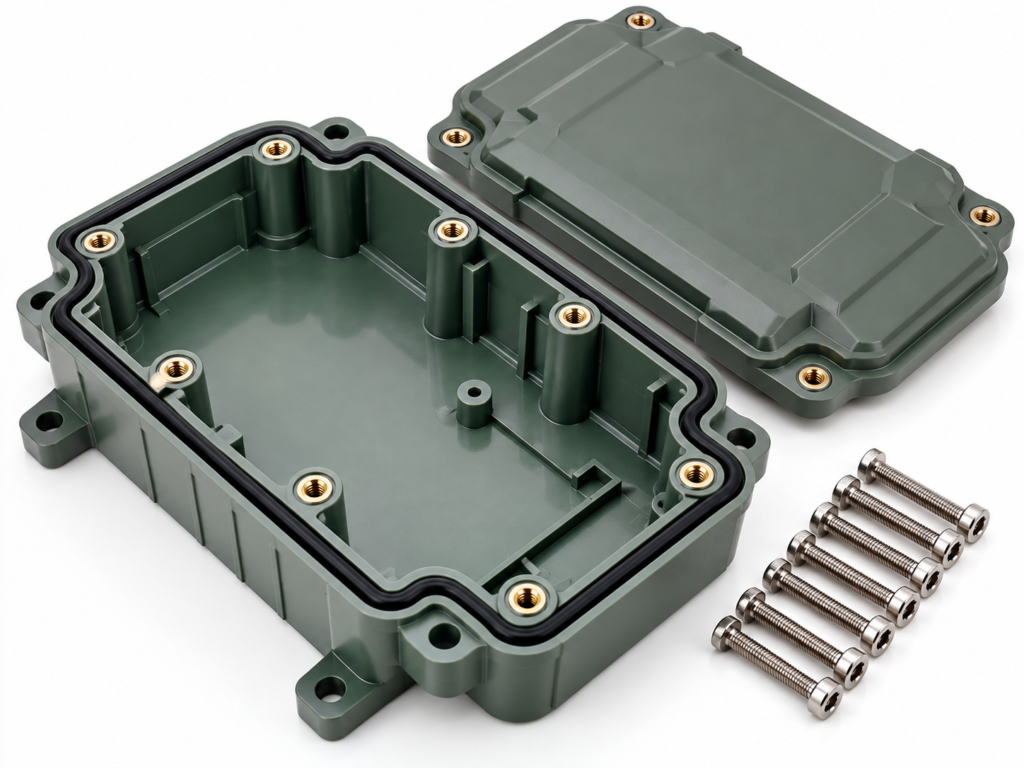
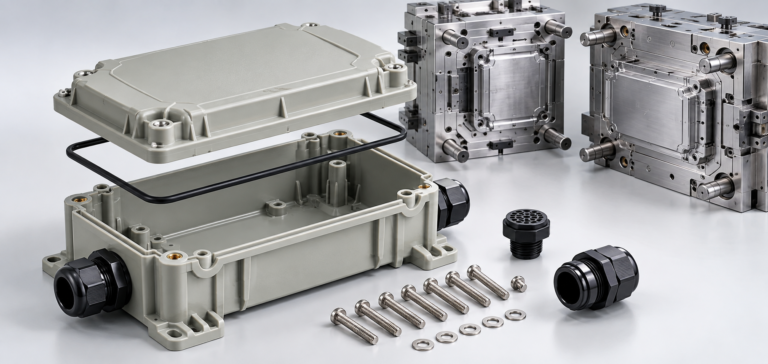
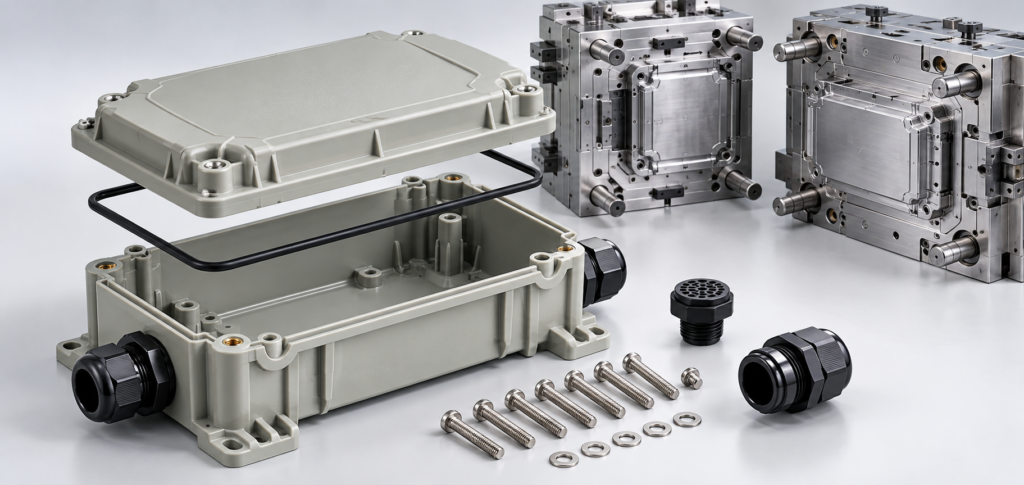
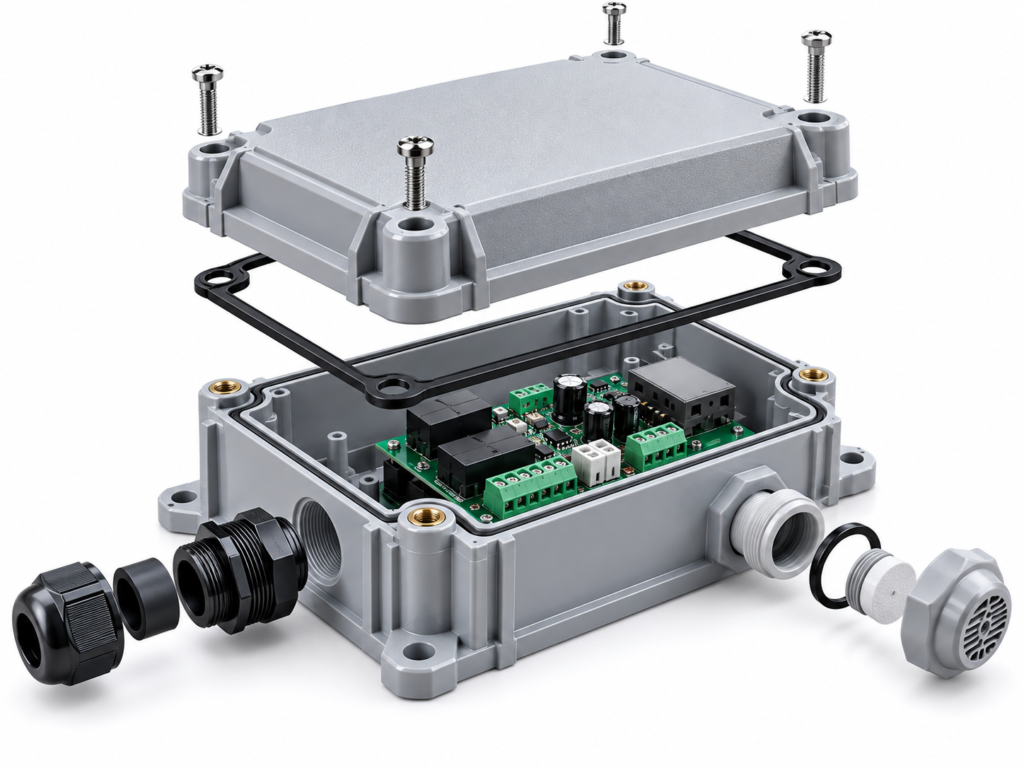
Reliable outdoor protection depends on the complete mechanical system: the housing geometry, gasket, sealing groove, fastening method, parting line, cable entry, pressure equalization, drainage and injection molding accuracy.

A housing may look completely closed in CAD but still leak during actual testing because of flange deformation, uneven gasket compression or dimensional variation after molding.

For this reason, waterproofing should be considered during the initial product and mold design stages rather than added after the first mold trial.

1. Waterproofing Is a System, Not a Single Feature

A common mistake is to assume that adding a rubber gasket automatically creates a waterproof product.

In reality, water can enter an enclosure through many different paths.

The joint between the upper and lower housings is only one potential leakage point. Fastener holes, connectors, cable glands, ventilation openings, display windows and poorly controlled molded surfaces can also become leakage paths.

More importantly, the gasket itself only works when the surrounding plastic structure provides consistent compression.

A practical waterproof design should therefore be considered as a complete system:

Housing structure → sealing surface → gasket → compression → fastening → cable interfaces → venting → drainage → molding accuracy → validation

If one element fails, the complete enclosure may fail its environmental test.


2. Understanding IP Protection Requirements

Outdoor enclosure development frequently involves an IP protection requirement.

The required level should be determined by the actual operating environment rather than simply specifying the highest possible rating.

Application EnvironmentMain ExposureDesign Priority
Covered outdoor equipmentHumidity, condensation, occasional rainBasic sealing and drainage
Outdoor electrical enclosureRain, dust, temperature cyclingReliable perimeter gasket
Agricultural equipmentWater, mud, dust, chemicalsRobust sealing and protected connectors
Outdoor lightingRain, condensation, UVSealing plus moisture management
Marine-related equipmentWater, humidity, salt environmentSealing and corrosion-resistant interfaces
Industrial outdoor equipmentDust, water spray, vibrationStructural sealing and stable fastening

An IP rating applies to the complete enclosure as tested, not simply to the gasket or plastic material.

Changing a cable gland, connector, vent or even assembly method can therefore affect final enclosure performance.

3. Gasket Design Is the Core of Many Waterproof Enclosures

For serviceable outdoor housings, elastomer gaskets are one of the most common sealing solutions.

Typical gasket materials include EPDM, silicone and other elastomers selected according to temperature, chemical exposure, compression behavior and outdoor requirements.

The gasket must remain continuously compressed between two mating surfaces.

However, more compression is not automatically better.

Insufficient compression can leave leakage paths, while excessive compression may permanently deform the gasket, increase assembly force or distort the plastic flange.

The required compression should therefore be determined according to the specific gasket material, hardness, cross-section and supplier recommendations.

The design must also consider long-term compression set. A gasket that seals successfully immediately after assembly may gradually lose recovery after prolonged compression and temperature exposure.


4. The Gasket Groove Must Control Position and Compression

A properly designed gasket groove does more than hold the rubber seal.

It controls gasket location during assembly and helps establish repeatable compression.

Important dimensions include groove width, groove depth, corner radius and the relationship between the gasket cross-section and available compression space.

Sharp corners should be treated carefully because the gasket must follow the complete sealing path without twisting or stretching excessively.

The sealing groove should also avoid unnecessary interruptions around screw bosses or structural ribs.

Gasket-Groove ProblemPossible Result
Groove too deepInsufficient gasket compression
Groove too shallowExcessive compression
Groove too narrowGasket distortion
Poor corner designLocal sealing instability
Interrupted sealing pathDirect leakage route
Warped flangeUneven compression
Excessive dimensional variationInconsistent waterproof performance

For precision outdoor housings, the gasket groove should be treated as a functional dimensional feature, not merely cosmetic geometry.


5. Screw Position Directly Affects Waterproof Performance

Fastener layout is another frequently underestimated design factor.

Consider a rectangular enclosure with screws only at the four corners. When the screws are tightened, the corners may generate sufficient compression while the center of a long flange remains slightly separated.

Even a very small gap can reduce sealing reliability.

Adding additional fastening positions along long edges can help distribute clamping force more uniformly.

However, adding screws without considering structural stiffness is not enough. The cover and lower housing must also resist bending under assembly load.

Ribs can therefore be used strategically to increase flange stiffness and transfer fastening force.

The objective is to achieve uniform gasket compression around the complete perimeter, rather than simply applying high torque at several isolated points.

6. Flatness and Warpage Matter More Than They Appear

A perfectly designed sealing groove can still fail if the injection molded housing becomes warped.

Large outdoor enclosures often contain long walls and wide flat surfaces. During injection molding, uneven shrinkage, cooling differences, fiber orientation or poor packing can cause deformation.

Imagine that the cover sealing flange is nominally flat in CAD but lifts locally after molding.

When assembled, the screws must force this distorted component back into position. Some regions of the gasket may become highly compressed while others receive insufficient pressure.

This is why waterproof enclosure design must connect product engineering with mold engineering.

Gate location, cooling layout, wall thickness, rib design and molding parameters can indirectly influence waterproof performance because they influence the dimensional stability of the sealing flange.


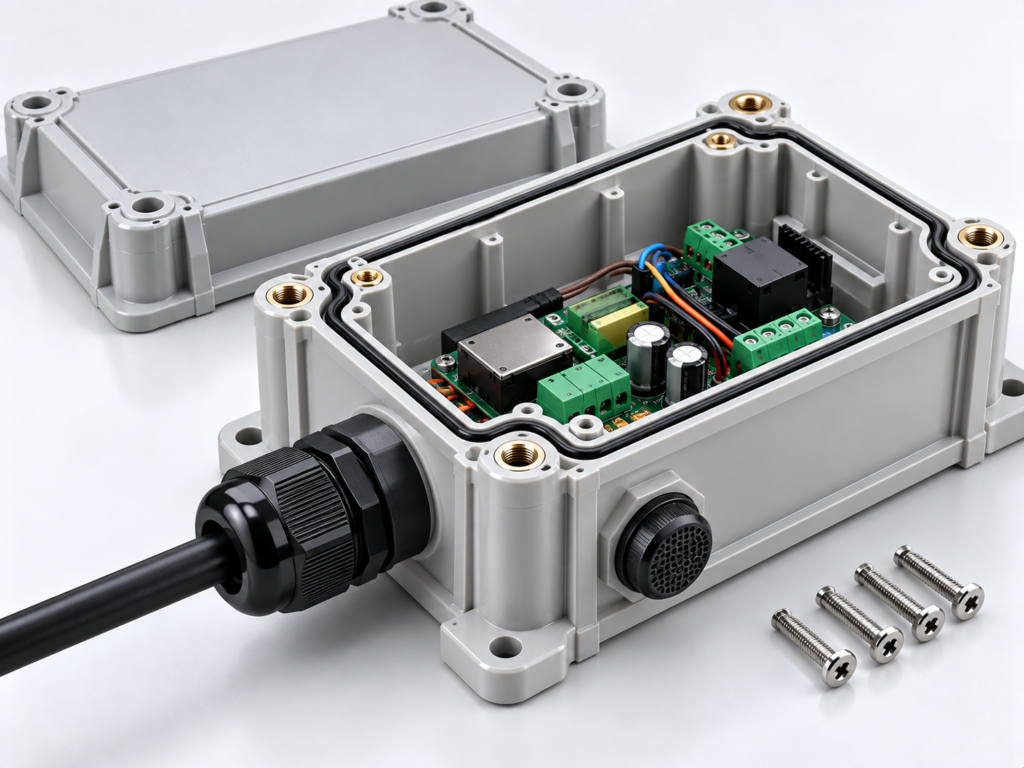
7. Cable Entries and Connectors Are Common Leakage Points

A housing can have an excellent perimeter gasket and still leak through its cable interfaces.

Outdoor products frequently require power cables, sensors, antennas, communication connectors or external switches.

These interfaces may use waterproof connectors, cable glands or specially designed seals.

The surrounding plastic wall should have sufficient stiffness to support the component without excessive deformation during tightening.

Threads also require attention. If a threaded plastic interface is part of the sealing system, dimensional accuracy and sealing method must be evaluated carefully.

The enclosure designer should therefore identify every penetration through the housing during the DFM stage and determine how each one will be sealed.


8. Pressure Equalization Can Improve Reliability

A completely sealed outdoor enclosure experiences internal pressure changes.

During daytime heating, the internal air expands. When the temperature drops, internal pressure decreases. Repeated heating and cooling can create pressure differentials across seals.

For sensitive electronic equipment, a properly selected hydrophobic vent membrane can allow pressure equalization while helping resist water and contaminants.

The vent should be positioned where it is unlikely to remain submerged or collect standing water.

It must also be protected from mechanical damage.

A vent should not be considered a substitute for a poor gasket. Instead, it forms another part of the overall environmental-control strategy.

9. Waterproof and Drainage Design Can Work Together

Not every external area of an outdoor product must be completely sealed.

Some regions can be deliberately designed to drain water before it reaches the primary sealing interface.

For example, an enclosure cover may incorporate an external lip or overlap that directs rain away from the gasket joint.

Drainage channels can prevent water from accumulating around fasteners or recessed surfaces.

This creates a useful design principle:

First prevent direct water exposure, then control remaining water with the primary sealing system.

A well-designed enclosure therefore uses geometry as the first defense and the gasket as a controlled sealing barrier.

This approach can improve reliability without unnecessarily increasing gasket compression or assembly complexity.


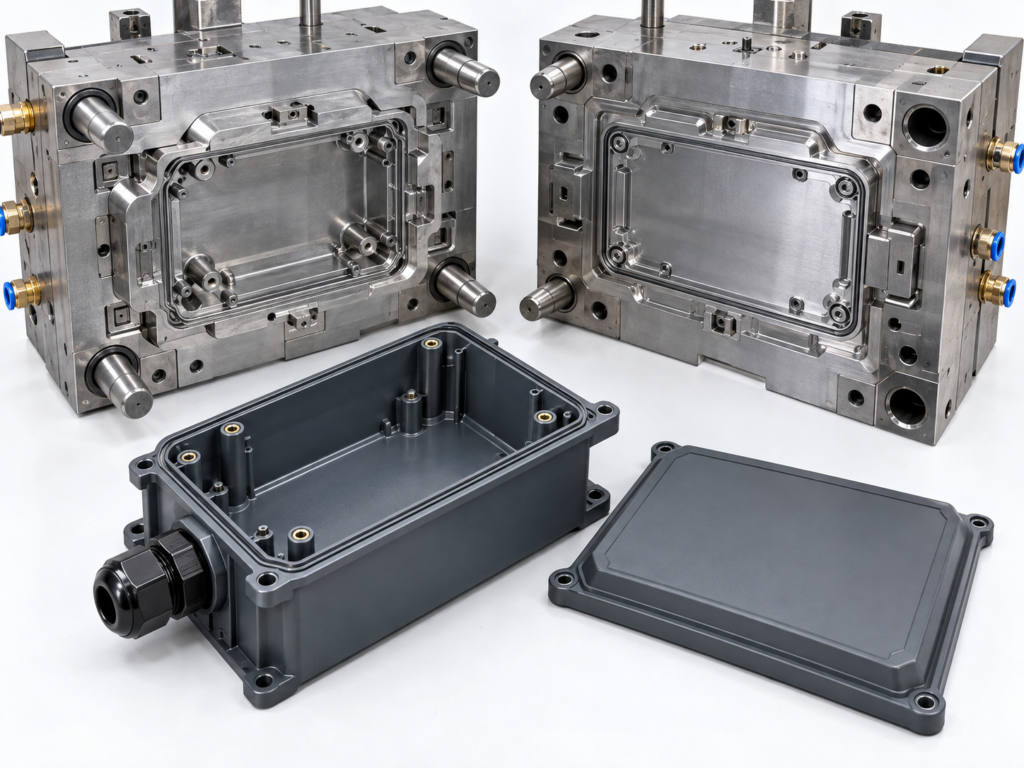
10. Mold Design Influences the Sealing Surface

The mold designer must understand which surfaces are critical to waterproof performance.

The gasket groove and sealing flange should receive appropriate dimensional and surface controls.

Parting lines should be positioned carefully. Flash or mismatch across a critical sealing surface can create potential leakage paths.

Ejector pins should also be positioned so they do not unnecessarily interfere with functional sealing areas.

Similarly, gate placement should consider the possibility of deformation around the sealing flange.

For complex outdoor housings, the DFM review should clearly identify:

critical sealing surfaces, gasket grooves, parting lines, shut-offs, dimensional tolerances and potential warpage areas.

This allows the mold design team to treat waterproof features differently from ordinary cosmetic surfaces.

11. T0/T1 Samples Should Be Tested as an Assembly

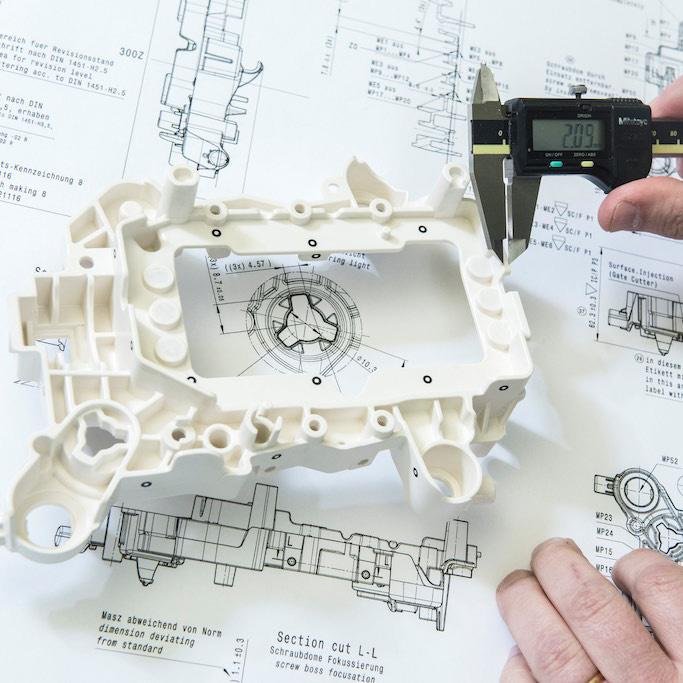
Dimensional inspection remains important after the first mold trial, but waterproof performance cannot be determined from dimensional reports alone.

The complete assembly should be evaluated.

A practical validation sequence is:

T0/T1 molding → dimensional inspection → gasket installation → controlled assembly → leakage/IP testing → failure analysis → process optimization → mold correction if necessary → confirmation testing

If leakage occurs, engineers should avoid immediately changing the gasket.

The actual cause may be flange warpage, incorrect screw torque, insufficient local compression, connector sealing or dimensional variation in the gasket groove.

A systematic failure analysis can prevent unnecessary mold modifications.


12. Common Waterproof Enclosure Failures

FailurePossible Engineering CauseArea to Check
Corner leakagePoor gasket positioningGroove and corner geometry
Leakage between screwsUneven flange compressionFastener spacing and stiffness
Leakage after agingGasket compression setElastomer selection
Connector leakageIncorrect interface sealingCable gland / connector
Intermittent leakageMolded-part warpageCooling, shrinkage and flatness
Seal damaged during assemblyGroove or gasket mismatchAssembly design
Internal condensationTemperature/pressure cyclingVentilation strategy
Leakage after repeated serviceSeal wear or incorrect reassemblyGasket retention and service design

This type of analysis is especially valuable because different failure modes can produce similar visible results.


13. Designing for Mass Production

A prototype enclosure can often pass a water test even when its design is not robust enough for mass production.

Production introduces material batches, molding-process variation, gasket tolerances, assembly torque variation and long-term tool wear.

A reliable design therefore requires a reasonable manufacturing window rather than a structure that only works at ideal dimensions.

Critical dimensions should be defined on engineering drawings, molding conditions should be stabilized, gasket specifications should be controlled and assembly parameters should be documented.

The objective is not to manufacture one waterproof sample.

The objective is to manufacture thousands of enclosures with repeatable sealing performance.


Conclusion

Waterproof outdoor plastic enclosure design is not simply a matter of adding a rubber gasket between two injection molded components.

Reliable environmental protection depends on the interaction between gasket material, sealing-groove geometry, flange flatness, screw distribution, structural stiffness, cable interfaces, pressure equalization, drainage and injection molding accuracy.

The design process should begin by defining the actual environmental requirement. Engineers can then establish the sealing strategy, optimize the enclosure geometry and review critical waterproof features during DFM and mold design.

After tooling, dimensional inspection and complete assembly testing should be combined to identify whether any failure originates from the molded component, gasket, assembly process or external interface.

When waterproofing is treated as an integrated engineering system from product design through mold validation, outdoor plastic enclosures can achieve more stable performance while reducing mold modifications and production problems.
Get the latest price? We will reply as soon as possible (within 12 hours)

Name

Plastic Injection Molding Tolerance: A Complete Guide to Dimensional Accuracy, ISO Standards, and Engineering Best Practices

Dimensional accuracy is one of the most critical quality indicators in plastic injection molding. Whether manufacturing medical devices, automotive components, consumer electronics, or industrial equipment, every injection molded part must meet specific dimensional requirements to ensure proper assembly, functionality, and long-term reliability.

Read more »

Outdoor Injection Molding Materials: A Complete Guide to Selecting Engineering Plastics for Harsh Environments

Outdoor plastic products face some of the harshest operating environments in modern manufacturing. Unlike indoor components, they must withstand continuous ultraviolet (UV) radiation, rain, humidity, temperature fluctuations, salt spray, dust, chemicals, and mechanical impacts over many years. Selecting the right engineering plastic is therefore one of the most important decisions during product development.

Read more »