Injection Molding DFM Report Analysis: A Complete Guide to Design for Manufacturability
Introduction
In the injection molding industry, a well-prepared Design for Manufacturability (DFM) report is one of the most important steps before mold manufacturing begins. A DFM report evaluates whether a plastic part can be produced efficiently, consistently, and cost-effectively while maintaining the required quality standards.
By identifying potential design issues at an early stage, DFM analysis helps prevent expensive mold modifications, production delays, dimensional problems, cosmetic defects, and assembly challenges.
For product designers, engineers, and buyers, understanding a DFM report can significantly reduce project risks and improve product development efficiency.
What is a DFM Report?
DFM (Design for Manufacturability) is a comprehensive engineering review conducted before mold design and mold manufacturing.
The purpose is to analyze the product structure and identify potential manufacturing issues such as:
- Non-uniform wall thickness
- Sink marks
- Warpage
- Undercuts
- Draft angle issues
- Difficult ejection
- Gate location concerns
- Air traps
- Weld lines
- Moldability risks
A DFM report acts as a bridge between product design and mold manufacturing.
Typical Injection Molding DFM Review Process


Why is DFM Analysis Important?
Many product development projects fail because manufacturability is not considered during the design stage.
Without DFM analysis:
| Potential Issue | Result |
|---|---|
| Poor wall thickness design | Sink marks and warpage |
| Insufficient draft angle | Part sticking in mold |
| Improper gate location | Short shots and cosmetic defects |
| Complex undercuts | Higher mold cost |
| Weak rib design | Structural failure |
| Poor cooling layout | Long cycle time |
Conducting DFM analysis before mold production can:
- Reduce mold modifications
- Improve product quality
- Shorten project lead time
- Lower manufacturing costs
- Increase production efficiency
- Improve dimensional consistency
Industry experience shows that design corrections made before mold manufacturing are significantly less expensive than modifications after mold completion.
Main Sections of a DFM Report
A professional injection molding DFM report typically includes several key analyses.
1. Wall Thickness Analysis
Wall thickness is one of the most critical factors affecting injection molding performance.
Uniform wall thickness promotes:
- Balanced material flow
- Consistent cooling
- Reduced shrinkage variation
- Better dimensional stability
Recommended Wall Thickness
| مادة | Recommended Thickness |
|---|---|
| ABS | 1.2 – 3.5 mm |
| PC | 1.0 – 4.0 mm |
| PP | 0.8 – 3.8 mm |
| PA66 | 0.8 – 3.0 mm |
| POM | 0.8 – 3.0 mm |
Large thickness variations may cause:
- Sink marks
- Voids
- Warpage
- Internal stress
Wall Thickness Analysis Example


2. Draft Angle Analysis
Draft angles allow molded parts to be ejected smoothly from the mold.
Insufficient draft can cause:
- Scratches
- Ejection marks
- Part deformation
- Mold wear
Typical Draft Recommendations
| Surface Type | Draft Angle |
|---|---|
| Smooth Surface | 1° – 2° |
| Textured Surface | 3° – 5° |
| Deep Core Features | 2° – 7° |
The DFM report highlights areas where draft angles are inadequate.
Draft Angle Analysis


3. Rib Design Analysis
Ribs are commonly used to increase stiffness without increasing wall thickness.
However, oversized ribs can cause sink marks on the opposite surface.
Recommended Rib Dimensions
| Feature | Recommended Value |
|---|---|
| Rib Thickness | 50%-70% of wall thickness |
| Rib Height | ≤ 3 × wall thickness |
| Rib Draft | 0.5° – 1.5° |
DFM engineers evaluate rib geometry to balance strength and appearance.
Rib Design Guidelines


4. Undercut Analysis
Undercuts are features that prevent straight mold opening.
Examples include:
- Snap fits
- Side holes
- Hook structures
- Internal locking features
Undercuts typically require:
- Sliders
- Lifters
- Collapsible cores
The DFM report evaluates whether undercuts can be eliminated or simplified to reduce mold complexity.
Slider and Lifter Design


5. Gate Location Analysis
Gate location directly influences:
- Filling balance
- Surface quality
- Weld line formation
- Shrinkage distribution
Common gate types include:
| Gate Type | Application |
|---|---|
| Edge Gate | General parts |
| Pin Gate | Multi-cavity molds |
| Submarine Gate | Automatic degating |
| Fan Gate | Large flat parts |
| Hot Runner Gate | High-volume production |
A DFM report recommends optimal gate locations based on product geometry.
Gate Design and Flow Pattern


6. Weld Line Analysis
Weld lines occur when two melt fronts meet.
Potential risks include:
- Reduced strength
- Visible surface defects
- Poor cosmetic appearance
Critical weld lines near:
- Screw bosses
- Snap fits
- Structural supports
require special attention.
DFM analysis identifies weld line locations and recommends gate modifications if necessary.
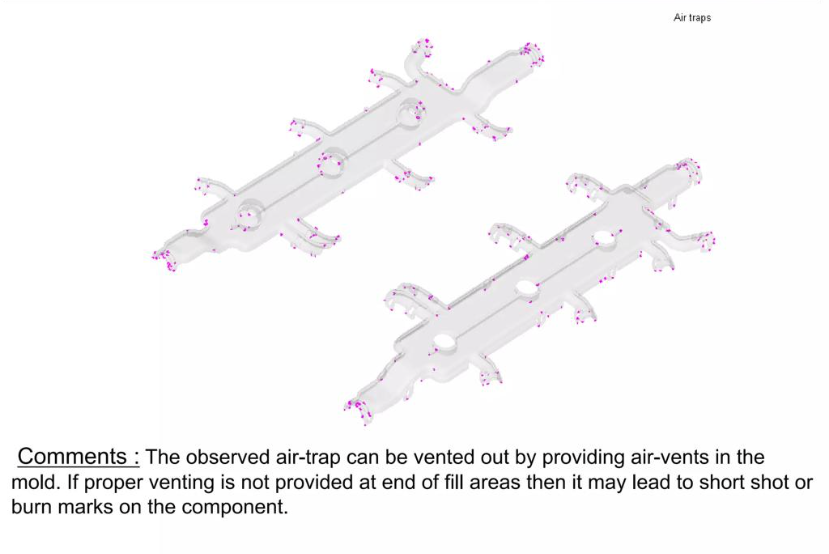
7. Air Trap Analysis
During injection molding, trapped air can lead to:
- Burn marks
- Incomplete filling
- Surface defects
The DFM report identifies areas where venting may be required.
Proper vent design improves:
- Filling performance
- Product appearance
- Production stability
Air Trap and Venting Analysis

8. Ejection Analysis
Part ejection is frequently overlooked during product design.
The DFM report evaluates:
- Ejector pin locations
- Part deformation risks
- Thin wall regions
- Cosmetic surface requirements
A well-designed ejection system reduces:
- Stress whitening
- Part distortion
- Surface damage
Ejection System Design

Mold Flow Analysis in DFM Reports
Many advanced DFM reports include Mold Flow Analysis (MFA).
Simulation results typically include:
- Filling analysis
- Packing analysis
- Cooling analysis
- Warpage prediction
- Weld line prediction
- Air trap prediction
These simulations help engineers optimize:
- Gate design
- Runner system
- Cooling channels
- Processing parameters
Mold Flow Simulation Results


Common DFM Recommendations
A professional DFM report often recommends:
Design Improvements
✓ Increase draft angles
✓ Optimize wall thickness
✓ Reduce undercuts
✓ Strengthen ribs
✓ Modify bosses
✓ Improve assembly features
Mold Design Improvements
✓ Adjust gate location
✓ Add sliders
✓ Improve venting
✓ Optimize cooling channels
✓ Enhance ejection systems
These recommendations improve manufacturability without compromising product functionality.
Benefits of Professional DFM Analysis
The benefits extend throughout the entire product lifecycle.
| Benefit | Impact |
|---|---|
| Reduced Tooling Risk | Fewer mold modifications |
| Better Product Quality | Lower defect rate |
| Faster Development | Shorter launch time |
| Lower Manufacturing Cost | Reduced scrap and rework |
| Higher Productivity | Stable mass production |
Many successful injection molding projects rely heavily on DFM analysis before mold manufacturing begins.
Conclusion
A comprehensive injection molding DFM report is much more than a design review document. It is a critical engineering tool that helps transform a product concept into a manufacturable, cost-effective, and high-quality production solution.
By analyzing wall thickness, draft angles, ribs, undercuts, gate locations, weld lines, air traps, and mold flow behavior, DFM engineers can identify potential problems before mold manufacturing starts.
For companies seeking reliable injection molding solutions, investing in professional DFM analysis is one of the most effective ways to reduce risk, improve product quality, and achieve successful mass production.
